
How to Find Diagonal Words in Strands Game
When you first play Strands, you might try finding words by looking from left to right, just like in a normal word search. But after a few minutes, you may notice that some words are not arranged in straight lines. This is because Strands allows you to connect letters diagonally. You can also change direction while making a word. If you don’t know this rule, you might miss an answer even when all its letters are right in front of you.
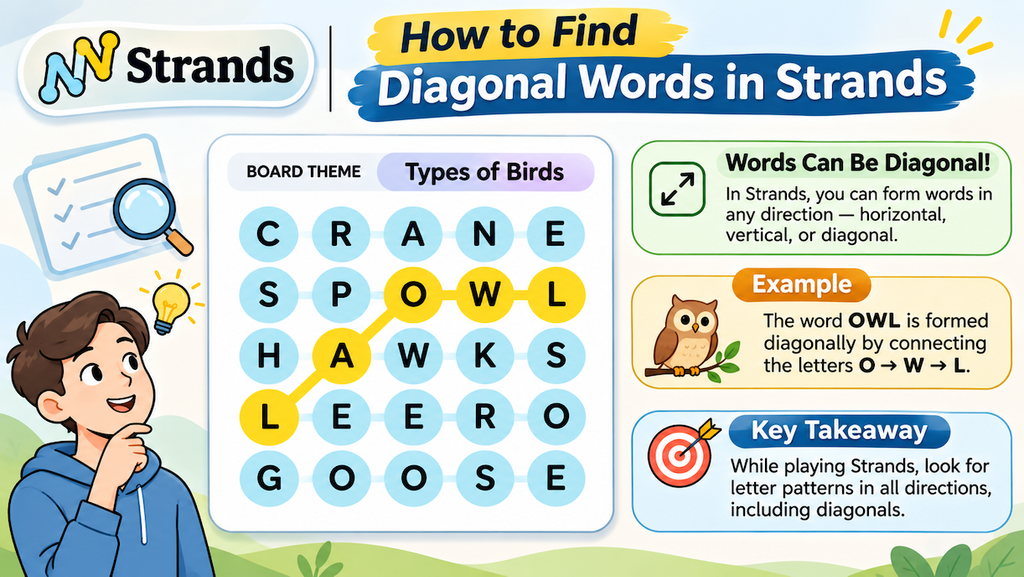
In this guide, we will explain how diagonal words work in Strands, show a few simple examples, and share some tips that can help you find hidden words more easily.
Jump to any section of this guide
Can You Form Words Diagonally in Strands?
Yes, you can connect letters diagonally in Strands.
In fact, diagonal connections are an important part of the puzzle game. Unlike a traditional word search, where words are often placed in straight lines, Strands allows you to move between neighboring letters in different directions.
You can connect letters:
- From left to right or right to left
- From top to bottom or bottom to top
- Diagonally in any direction
You can also combine these movements while making one word.
Example: you might start a word by moving diagonally down, then move right, and finally move up to reach the last letter. The important rule is that each new letter must be touching the previous letter.
What Does a Diagonal Connection Look Like?
Imagine you have this small group of letters:
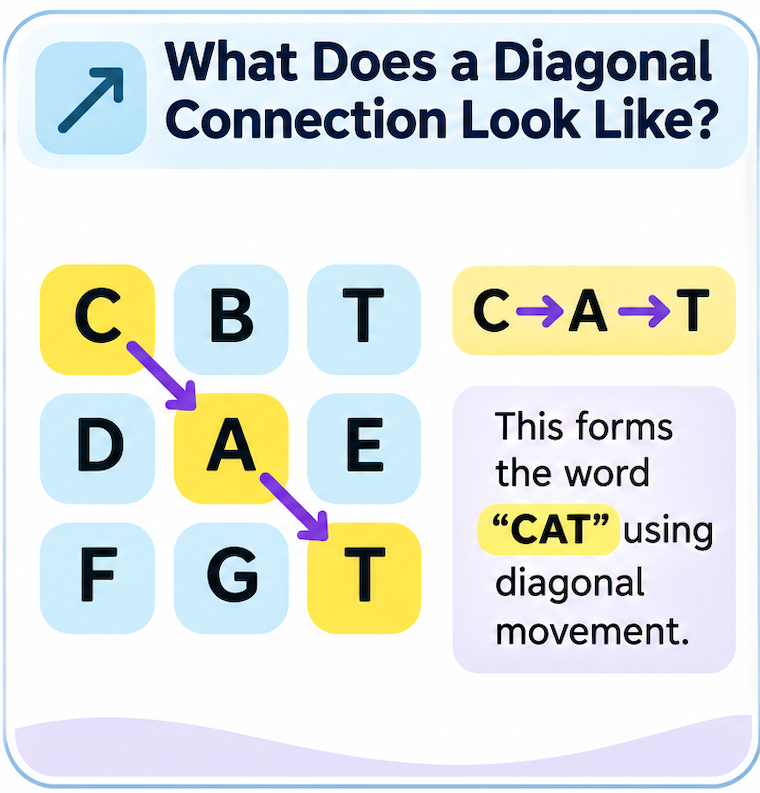
Look at the letters C, A, and T. You can connect them like this:
C → A → T
Start at C in the top-left corner, move diagonally down to A in the middle, and then move diagonally down to T in the bottom-right corner.
That creates the word CAT.
This is a simple example of how diagonal movement works. Of course, in a real Strands puzzle, the board is much larger and the words may change direction several times.
Can a Word Change Direction?
Yes. This is one of the most interesting parts of Strands Word Connect Game. A word does not have to follow one straight path.
Let’s look at another example:
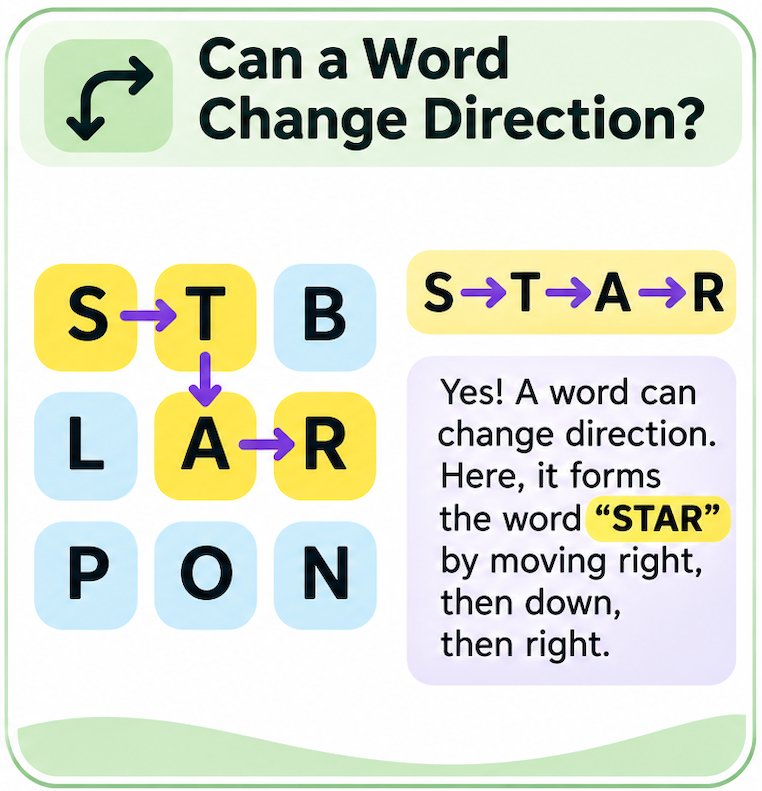
Suppose you want to form the word STAR. You can connect:
S → T → A → R
Start at S in the top-left corner, move right to T, move diagonally down-left to A, and then move right to R. The word changes direction, but every letter is still next to the previous one. This is allowed in Strands. Once you understand this, you will start noticing more possible words on the board.
Can You Use the Same Letter Twice?
No. You cannot use the same letter tile twice while forming one word.
Example: if you start a word using a letter in the middle of the grid, you cannot return to that exact tile later in the same word. However, if the board contains the same letter in two different positions, you can use both tiles. Imagine a word needs two A’s. You must find two separate A tiles and connect them through a valid path. This rule is important because it prevents you from making words by repeatedly moving back and forth over the same letters.
How to Find Diagonal Words More Easily
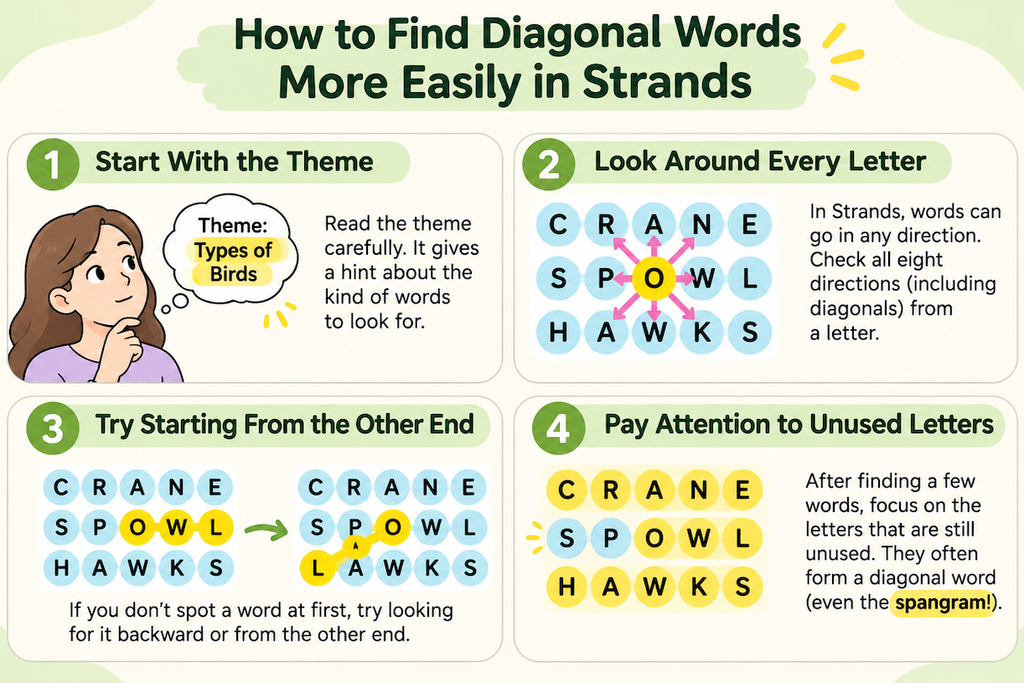
Finding diagonal words can feel difficult at first, especially when the board contains many letters. Here are a few things that may help you to find diagonal word.
1. Start With the Theme
Before looking for words, read the clue at the top of the puzzle. The clue tells you what kind of words you should be searching for.
Example: If the theme is about animals, you might think of words such as TIGER, HORSE, or RABBIT. Now look for the starting letters of those words. If you see a T, check the letters touching it, including the diagonal ones. You might find the next letter of a possible answer.
2. Look Around Every Letter
When you find the first two letters of a word, don’t just look in the same direction. Check all the neighboring tiles. Sometimes the next letter is directly above or below. Other times, it’s diagonally beside the letter you are selected. This small habit can help you notice words you would otherwise miss.
3. Try Starting From the Other End
Sometimes you can recognize the ending of a word more easily than its beginning.
Example: You might notice the letters I, N, and G close together. If the theme suggests a word ending in ING, try working backward to see whether the remaining letters connect. You still need to select the completed word in its correct spelling order, but looking backward can help you discover the path.
4. Pay Attention to Unused Letters
When you find a correct theme word, its letters become highlighted. As more words are found, the remaining letters become easier to examine. Instead of searching the entire board again, focus on the spaces that have not been used. Look for diagonal connections between those remaining letters. You may find that a word bends around another completed answer.
Do Diagonal Rules Apply to the Spangram?
Yes. The Spangram follows the same letter-connection rules as other theme words. It can move horizontally, vertically, and diagonally. It can also change direction. The difference is that the Spangram describes the main theme and connects two opposite sides of the puzzle grid.
Example: A Spangram might begin near the left edge, move diagonally through the middle, and finish at the right edge. It doesn’t have to travel in a straight line. If you are having trouble finding the special word, checking diagonal paths near the edges of the board can be helpful. You can read our guide on what a Spangram is and how to find one for more information.
Common Mistakes Beginners Make
One common mistake is looking only for straight words. Another is assuming that diagonal movement must continue in the same direction until the word is complete. Neither is true in Strands. You can change direction as long as the next letter touches the current letter. Some players also try to jump over one tile to reach another letter. This is not allowed in this game.
If a word looks correct but the game doesn’t accept it, check whether every letter connects properly and whether you are accidentally selected the same tile twice. Also remember that a correctly spelled word may not be part of the puzzle’s theme.
Practice With a Simple Example
Let’s imagine the theme is about pets. You think the word DOG might be hidden in the grid.
- First, find a D.
- Next, look for an O touching that D. The O might be directly beside it or diagonally below.
- Then check whether a G touches the O.
- If all three letters connect, you have a valid letter path for DOG.
Whether it counts as a theme answer depends on the actual puzzle. You can try the same method with longer words. The more letters a word has, the more important it becomes to check different directions.
Final Thoughts
Diagonal movement is one of the rules that makes Strands different from an ordinary word search. You are not limited to straight lines. You can move diagonally, turn corners, and follow winding paths to make words. The main thing to remember is simple: every letter must touch the letter before it, and you cannot reuse the same tile within one word.
If you are new to Strands, don’t worry if finding diagonal words takes time. Start with short words, study the theme, and check the letters around each tile. You can play Strands online and practice finding diagonal words yourself. Once you get used to following different letter paths, the puzzle becomes much easier to understand. Thanks to read.